India's creator economy is one of the fastest-growing digital sectors globally, powered by smartphone penetration, rural internet adoption, and the rapid deployment of generative AI tools. This report presents 60+ statistics on how AI voice technology is transforming YouTube automation in India — from faceless channel adoption to RPM benchmarks and the emerging era of agentic AI content.
1. India's Creator Economy and YouTube Market Data
| Metric | 2025–2026 Data |
|---|---|
| Indian creator economy valuation | USD 1.45 billion |
| Creator eco annual CAGR | 22.2% |
| Creator economy GDP contribution | ₹30,000 crore by 2026 |
| Total YouTube users in India | 500 million active users |
| Total active internet users in India | 912 million (projected by 2026) |
| Number of AI-assisted creators | 12 million |
| AI-generated Indian video market | USD 1.2 billion |
| Creators using generative AI in workflows | 99% report active usage |
| Creators excited about agentic AI | 90% |
| Indian creators saying generative AI strengthens creator economy | 97% |
Key context: Rural India has surpassed urban India in internet penetration. The "Bharat" market — Tier-2 and Tier-3 cities — exhibits a strong preference for regional language content in Hindi, Tamil, Bengali, Telugu, and other Indic languages, driving the demand for automated multilingual video production at scale.
2. Faceless Channel Adoption Statistics
Faceless AI-led content has moved from niche experiment to dominant production standard in India.
- By early 2026, approximately 75% of new educational and infotainment channels in India have adopted a faceless or AI-led format.
- Faceless channels operate at 2–3× faster production cycles than traditional on-camera formats.
- The faceless model allows creators to pivot niche strategy based on algorithmic trends without confusing an audience attached to a specific human personality.
- A single operator running an "AI factory" model can manage a portfolio of dozens of channels, collectively generating thousands of dollars in monthly revenue.
- One documented case: an Indian creator runs 30 faceless YouTube channels simultaneously using AI automation.
- Another documented case: an Indian creator generates $4,500/month from AI factory videos.
- The demographic of automated creators is shifting — the current wave includes white-collar professionals and students using AI for side-income streams, not just metro-based early adopters.
- Creators are increasingly described as "systems architects" — managing teams of AI agents for research, scripting, and editing rather than filming themselves.
| Content Category | % Using AI Voices (2025) | Key Market Driver |
|---|---|---|
| Educational / Tutorials | 70%+ | High demand for UPSC, JEE exam prep |
| Infotainment / News | 75% | Real-time reporting, regional reach |
| Finance / Investing | 60%+ | High RPM, need for neutral authority |
| Mythology / Culture | 55% | Evergreen storytelling, public domain assets |
| Horror / Storytelling | 50% | Atmospheric immersion, regional dialects |
The 2026 Shift: Faceless No Longer Means No Face
The faceless model was always a compromise. Stock footage and Ken Burns pans over screenshots are cheap and fast, but they cap watch time, and channels in the explainer and finance niches keep hitting the same ceiling: viewers trust a person more than a slideshow.
Talking avatars change that trade-off. You still never appear on camera, but the video now has a presenter delivering the script. For Indian channels this only works if the presenter looks Indian, which is where the global tools fall down — a Western avatar dubbed into Hindi reads as inauthentic within seconds and the retention data shows it.
VoisLabs ships 32 Indian presenters across 15 Indian languages at ₹25 to ₹50 per minute of video, against roughly ₹186 per minute on Synthesia and ₹240 on HeyGen. Credits are one-time, which matters for the portfolio operators described above, since a subscription minute allowance is wasted on any channel that has a slow month.
Where it fits in an automated pipeline:
| Video type | Best format |
|---|---|
| Explainers, finance, exam prep | Talking avatar intro plus b-roll body |
| Mythology and long-form storytelling | Voice only over visuals; avatars drift past 2 minutes |
| Shorts and community posts | Full talking avatar |
| News and daily updates | Talking avatar with the announcer presenters |
The practical pattern is a hybrid: open with 20 seconds of a presenter to establish trust, then cut to footage for the body. That keeps cost down, since you only pay avatar rates for the segment that needs a face.
See how to make a talking avatar video for the walkthrough, or browse the presenters.
3. AI Voice Technology Architecture for Indian Content
The success of automated Indian channels is directly tied to the technical sophistication of their synthetic speech engines. General global models consistently underperform on Indian linguistic patterns — driving the development of specialised Indic TTS architectures.
The Core Technical Pipeline
| Technology Component | Function in Indian Context | Impact on Content Quality |
|---|---|---|
| MFCC Extraction | Captures unique vocal characteristics from audio samples | Ensures authentic "Desi" resonance |
| Tacotron 2 Architecture | Maps text to mel-spectrograms | Facilitates smooth Hinglish transitions |
| HiFi-GAN Vocoder | Converts spectrograms to audible waveform | Adds texture, reduces "robotic" feel |
| Accent Adaptation Layer | Fine-tunes regional inflections without full retraining | Enables hyper-local dialect targeting |
| Low-Latency Inference | High-speed cloud audio generation | Critical for live news and streaming |
Key technical statistics:
- Modern Indian TTS platforms support over 175 languages and dialects, enabling creators to target underserved rural markets.
- The "accent adaptation layer" allows a single AI narrator to shift between regional inflections — a tech reviewer can record in English and generate Hindi, Tamil, and Telugu dubs with correct phonetic nuances from the same voice model.
- Hinglish (Hindi-English code-switching) is the standard communication mode for a large portion of India's digital population — TTS models must handle mid-sentence language transitions with zero latency and natural prosody.
- Enterprise deployments like India Today Group use real-time AI dubbing to reach 500 million viewers in multiple regional languages from a single live broadcast.
- Low-latency cloud inference is critical for live news dubbing and interactive voice response systems — latency above 200ms breaks perceived naturalness.
4. Niche Taxonomy: RPM Benchmarks by Category
Niche selection is the most significant determinant of long-term sustainability for an automated channel. Indian CPM rates are approximately 1/25th of international rates, making niche selection — not just volume — the primary lever for profitability.
| Niche Category | RPM (INR) | Growth Trend | Key Tools |
|---|---|---|---|
| Finance & Investing | ₹180 – ₹280 | High / Upward | Animated charts, authoritative TTS |
| Career / Exam Prep | ₹80 – ₹150 | Moderate / Steady | Whiteboard animations, neutral TTS |
| Tech Reviews | ₹50 – ₹120 | High / Saturated | Unboxing B-roll, energetic TTS |
| Mythology / History | ₹40 – ₹90 | Steady / Evergreen | AI avatars, cinematic stock footage |
| Horror Storytelling | ₹20 – ₹50 | High / Viral | Atmospheric audio, suspenseful TTS |
Additional niche insights:
- A well-monetised finance or tech channel can generate approximately ₹50,000 in monthly AdSense revenue for every 500,000 views.
- Personal finance channels focused on SIPs and funds are particularly effective with neutral, authoritative AI voices and dynamic chart overlays.
- Mythology and horror channels benefit from the "compound effect" — a large back-catalogue of evergreen videos generates passive revenue for years with no additional production cost.
- Analysis of 147 subreddits identified 47 faceless YouTube micro-niches where Indian creators are quietly earning ₹2–8 lakhs monthly.
- High-specificity B2B niches — such as GST compliance, export procedures, and legal advisory — have low competition but high engagement from users with specific transactional intent.
- Exam preparation niches (UPSC, JEE, NEET) frequently monetise through affiliate sales of online courses and EdTech partnerships, supplementing AdSense revenue significantly.
5. Monetization Architecture: Revenue Benchmarks
Monetization for automated Indian channels in 2026 is layered. Reliance on AdSense alone is not viable given Indian CPM rates — successful creators build diversified revenue stacks.
Production Cost Breakeven Model
- Typical production cost per video: ₹1,200.
- Views required to break even at blended RPM of ₹60: approximately 20,000 views.
- Videos longer than 8 minutes enable mid-roll ads, potentially doubling revenue versus shorter formats.
- Bilingual metadata strategy — titles like "How to Save Money (Paisa Bachane Ka Tarika)" — captures both English and Hindi search intent, expanding potential audience reach.
Revenue Benchmarks by Stream
| Revenue Stream | Monthly Potential (INR) | Primary Driver |
|---|---|---|
| AdSense (500k views) | ₹30,000 – ₹80,000 | Niche-specific RPM, watch time |
| Affiliate Marketing | ₹50,000 – ₹1,00,000 | Product-niche alignment, trust |
| Sponsorships | ₹30,000 – ₹3,00,000 | Audience demographics, engagement |
| Digital Products / Courses | ₹50,000 – ₹2,00,000 | Expert authority, lead generation |
| Total Blended | ₹1.6L – ₹6.8L+ | Multi-stream diversification |
Sponsorship Rate Benchmarks
- Nano-influencers (10k–50k subscribers): ₹4,000 – ₹25,000 per video.
- Top-tier financial creators: ₹10–12 lakh per high-impact integration.
- Faceless channels face unique challenges securing sponsorships — brands often prioritise "human-made authenticity." Channels overcome this by demonstrating 60%+ audience retention rates and active comment engagement.
- Affiliate marketing outperforms traditional ads in conversion rates — product reviews and tutorials are the highest-converting format.
- Digital products (e-books, templates, courses) offer the highest profit margins as creators retain 100% ownership with zero incremental production cost per sale.
6. 2025–2026 Regulatory Environment
The era of unlabelled AI content in India ended with YouTube's July 2025 policy overhaul and the enforcement of India's Digital Personal Data Protection (DPDP) Act 2023.
| Compliance Requirement | Triggering Action | Consequence of Non-Compliance |
|---|---|---|
| "Altered Content" label | Realistic AI voice or face swap | Demonetization, channel strikes |
| DPDP Act 2023 consent | Voice cloning of any third party | Legal liability, channel ban |
| Originality standard | Mass-produced template content without unique value | "Repetitious content" flag, demonetization |
| Community Guidelines | Misleading AI news or medical claims | Video removal, permanent ban |
| Likeness management | AI singing/voice simulation of real people | Content ID claims, removal |
Key regulatory statistics and implications:
- YouTube now requires mandatory disclosure for all realistic AI-generated voices via a new upload toggle — displayed in the video description or overlaid on the video itself for sensitive topics including finance, health, and news.
- India's DPDP Act 2023 mandates explicit written consent for use of any individual's likeness — including face and voice. Creators can clone their own voice freely, but using a celebrity or third-party voice without consent is prohibited.
- YouTube's 2026 "authenticity score" uses both ML classifiers and human reviewers to detect "AI slop." Reviewers specifically look for human editorial oversight signals — custom transitions, thoughtful pacing, and narrative arcs that feel curated rather than algorithmically assembled.
- Content using overused AI footage or repetitive templates without unique value is increasingly difficult to monetise under 2026 policies.
- Human-voiced content continues to earn higher RPM than purely AI-voiced content due to higher viewer retention — making "hybrid" human+AI production the optimal strategy.
7. Audience Psychology and Engagement Metrics
Voice quality is a primary driver of algorithmic success in India's crowded content market. The "auditory identity" of a channel functions as its brand signature.
| Engagement Metric | Impact of High-Quality TTS | Strategic Implementation |
|---|---|---|
| First 3-second retention | Up to 80% increase | Strong, emotional opening hooks |
| Video completion rate | 47% higher | Conversational pacing, dynamic tonal shifts |
| Average watch time | 23% increase | Tonal changes every 15–20 seconds |
| Click-through rate (CTR) | Varies by implementation | Narrated CTAs outperform text overlays |
| Viewer loyalty | Higher series completion | Consistent voice identity across all uploads |
Key engagement data points:
- The first 3 seconds of a video are critical for retention decisions on YouTube Shorts and Instagram Reels.
- High-fidelity AI voices that capture attention instantly can boost view time by up to 80%.
- Videos with professional narration see 47% higher completion rates compared to silent or visuals-only content.
- Average watch time increases by 23% when narration tone changes at least twice within the first 30 seconds — a technique known as "tonal shifting."
- Channels using robotic or flat synthetic voices report RPMs under USD 2 because viewers click away faster, reducing total ad impressions.
- Human-like AI voices that adjust tone and pace dynamically keep audiences past the 8-second drop-off threshold — the critical moment where most viewer losses occur.
- Some viewers report actively blocking channels that use poorly implemented AI voices — mispronunciations and "butchered" scripts cited as primary reasons for departure.
- An AI narrator that understands local Hinglish idioms and slang is perceived as more authentic than a generic global voice, directly impacting trust and subscriber retention.
Tonal Strategy by Niche
- Mythology and History: Calm, authoritative tone — builds gravitas and viewer trust for long-form storytelling.
- Finance and Tech News: Energetic, fast-paced tone — signals urgency and authority for high-value information.
- Exam Preparation: Neutral, measured tone — reduces cognitive load for learners processing dense curriculum material.
- Horror Storytelling: Atmospheric, suspenseful pacing — builds immersion without expensive location filming.
8. Case Studies: Real Results from Indian Creators and Brands
| Case Study | Niche / Type | Key Result | Core Strategy |
|---|---|---|---|
| Money4India (BossWallah) | Finance in Hindi | 100,000 subscribers in 6 months | 2–3 uploads/week; high editorial quality scripts; automated visual assembly |
| India Today Group | Live news (multi-language) | 500 million viewer reach from single feed | Real-time AI dubbing into multiple regional languages |
| NEWME (Fashion Brand) | Fashion marketing | Higher CTR and conversion rates | AI-driven product cataloguing and ad creative pipeline |
| FanCode (Sports) | Live cricket coverage | 100 million user engagement | AI-powered voice translations for CPL broadcasts |
| "Abundance Affirmations" (Warning) | Mindfulness / Affirmations | Only 3 subscribers in one week despite $200/month tool spend | Failed due to market saturation and zero unique value — identical AI "reused" content |
Key lessons from case studies:
- Money4India achieved 10% month-over-month subscriber growth by maintaining high editorial standards for scripts while automating visual assembly — the combination of volume and quality, not volume alone.
- India Today's deployment illustrates the shift from individual creator "side-hustles" to large-scale institutional use of AI voice for national-scale reach.
- The "Abundance Affirmations" failure demonstrates that tools like ElevenLabs and InVideo are not a replacement for a unique creative angle — saturated niches with template content fail regardless of tool quality.
- The critical success factor across all case studies is niche defensibility — channels that own a specific angle compound over time, while generic channels plateau immediately.
9. Future Outlook: Agentic AI and Autonomous Channels (2026–2030)
The trajectory of YouTube automation in India points toward full-stack AI management of content channels — from trend detection to publishing optimisation.
- By end of 2026, synthetic speech is expected to become indistinguishable from human narration in blind listener tests at standard streaming quality.
- Photorealistic AI avatars can now deliver scripts in over 175 languages with precise lip-syncing and culturally resonant gestures — creating a consistent "virtual anchor" brand asset owned entirely by the creator.
- "Autonomous channels" managed by agentic AI will not only generate content but also continuously monitor trends, identify content gaps, and publish videos to meet emerging demand — without human input per video.
- Agentic systems will monitor platforms like Reddit in real-time to identify underserved queries and instantly produce targeted content to rank for them.
- For brands, this means a shift from one-off creator posts to ongoing partnerships with automated "humanised" entities acting as full-time AI brand ambassadors.
- India's sovereign AI push — through Bhashini and startups like Sarvam AI — is building Small Language Models (SLMs) specifically for Indic vernacular contexts, prioritising data residency, regulatory compliance, and inclusion of underrepresented languages.
- The maturation of hyper-realistic synthetic speech represents a direct threat to traditional Indian BPO and IT services firms — major VCs warn that legacy roles could drastically diminish within five years due to AI automation of voice-based work.
- Conversely, this disruption creates opportunity: India is positioned to shift from IT service exporter to AI product exporter — building specialised, domain-trained voice agents for global markets.
Sources
- TrueFan AI — Build a Hinglish Faceless YouTube Channel in India 2026
- Global Media Insight — YouTube Statistics 2026
- TrueFan AI — AI Spokesperson for YouTube India
- TrueFan AI — Vernacular Video Automation India
- TrueFan AI — Faceless YouTube Channel Ideas India 2025
- NarrationBox — Faceless YouTube Channel Ideas That Work
- BuzzInContent — 97% of Indian Creators Say Generative AI Strengthens Creator Economy
- TrueFan AI — AI Voice Cloning Indian Accents
- TrueFan AI — Hinglish AI Video Generator
- ElevenLabs — Free Indian Accent Text to Speech
- CAMB.AI — Localization AI for Content and Sports
- BossWallah — Faceless YouTube Channel Ideas Low Competition
- BossWallah — YouTube Sponsorship Rates 2025
- BossWallah — YouTube AI Monetisation Policy 2026
- TrueFan AI — YouTube AI Labeling Policy India
- MilX — AI Voice vs Human Voice on YouTube: What Drives Higher Earnings?
- NarrationBox — Top Human-Like AI Voices 2025
- NarrationBox — Human-Like AI Voices for Instagram 2026
- Reddit r/indianstartups — 47 Faceless YouTube Niches Earning ₹2–8 Lakhs Monthly
- OutlierKit — Top Niches for YouTube Automation 2026
- ET Edge Insights — Building AI Models That Work for India
- Vegavid — AI Voice Assistants for Indian Regional Languages 2026
- YouTube — This Guy Is Running 30 Faceless YouTube Channels
- YouTube — Indian Makes $4,500/Month From AI Factory Videos
Start Automating Your YouTube Channel with VoisLabs (Free)
Ready to automate your own faceless YouTube channel? Here's the 5-step playbook that works for the creators earning ₹50K–₹3L/month above:
- Pick your niche + language — Hindi finance, Tamil mythology, Telugu commentary, Malayalam PSC prep, Bengali literature. The niches with the highest Hindi RPM (₹400+ per 1K views) are documented in section 4 of this guide.
- Write your script — 700–800 Hindi words for a 5-minute video, 100–150 words for a Short. Use Devanagari (हिन्दी) script for cleaner pronunciation. Aim for one video every 2–3 days at minimum to feed the algorithm.
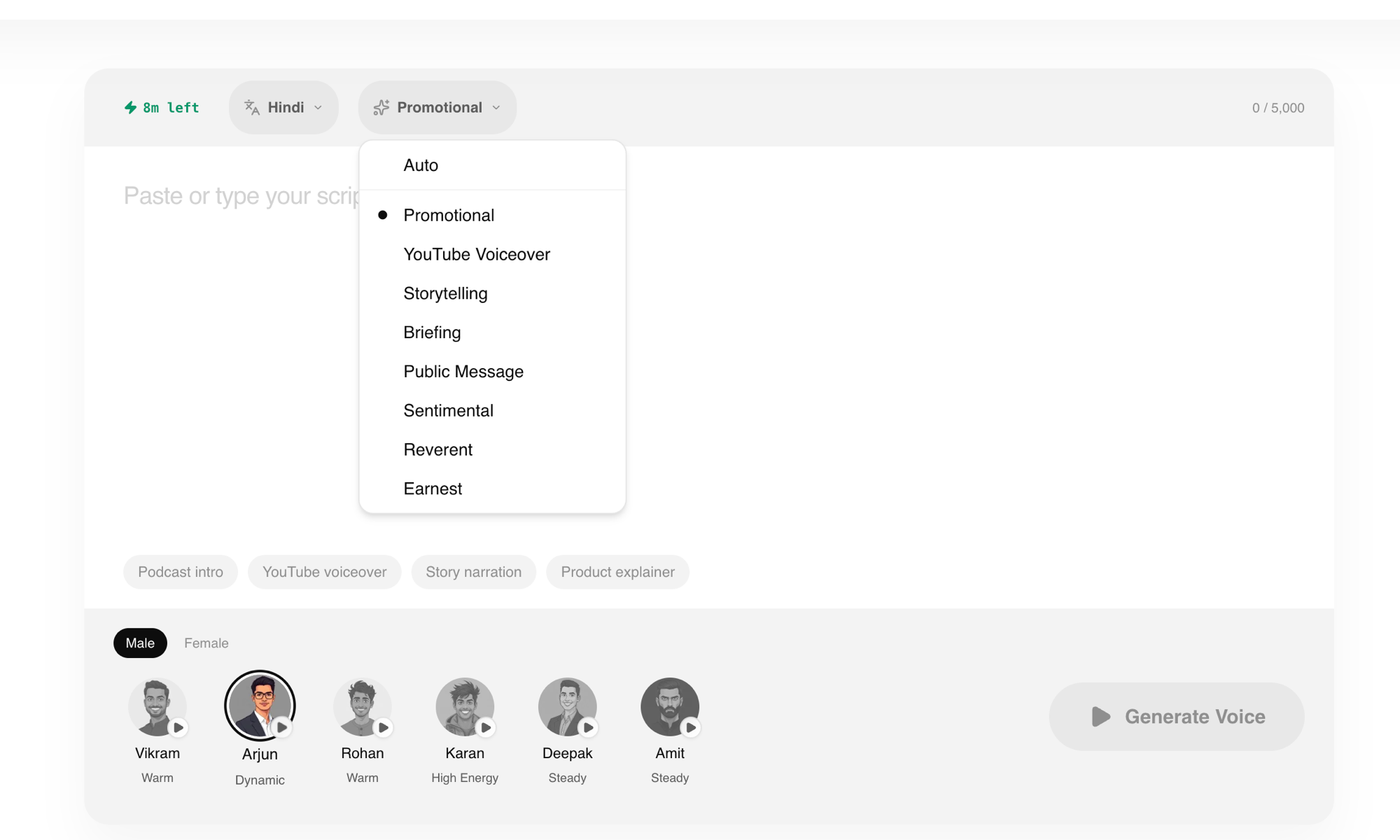
- Generate AI voiceover with VoisLabs — Pick a Hindi voice (Sulafat for storytime, Achird for commentary, Aoede for devotional) and a narrative-style preset. Generate the MP3 in seconds. Every new account gets 2 free minutes; the ₹299 Starter pack adds 18 minutes that never expire.
- Add visuals + export to YouTube — Use VoisLabs' built-in audio-to-video pipeline to bundle the voiceover with stock visuals and karaoke subtitles in Devanagari (no Western subtitle tool renders Hindi script correctly). Export 9:16 for Shorts, 16:9 for standard YouTube.
- Publish + monetize — YouTube allows AI voiceover with original scripts. Apply for Partner Programme at 1K subscribers + 4K hours. Monetization typically begins month 3–6 for Hindi finance/commentary niches.
Start free in your language
VoisLabs offers studio-quality AI voices across 12 Indian languages. The 2 free minutes need no credit card:
- Hindi Text to Speech (हिन्दी) — 600M speakers, India's biggest YouTube audience
- Tamil Text to Speech (தமிழ்) — Kollywood reviews, tech content, education
- Telugu Text to Speech (తెలుగు) — Tollywood, political commentary, farming tutorials
- Bengali Text to Speech (বাংলা) — Literature, food vlogs, Durga Puja content
- Malayalam Text to Speech (മലയാളം) — PSC prep, Gulf NRI content
- Kannada Text to Speech (ಕನ್ನಡ) — Bangalore tech, Sandalwood reviews
- English (Indian Accent) — Pan-India business and education content
Or jump straight to the dedicated use-case guides:
- Hindi YouTube Voiceover Playbook — कहानी, horror, commentary, devotional channels
- Indian-Accent Voiceover for Brand Content — ads, brand films, D2C product videos
- Best Hindi TTS Tools 2026 — 13 Compared — head-to-head review
→ Open the VoisLabs Voice Studio (free) — pick a language, choose a preset, generate your first voiceover in 30 seconds.
Try VoisLabs — start creating in seconds.
Open Voice Studio